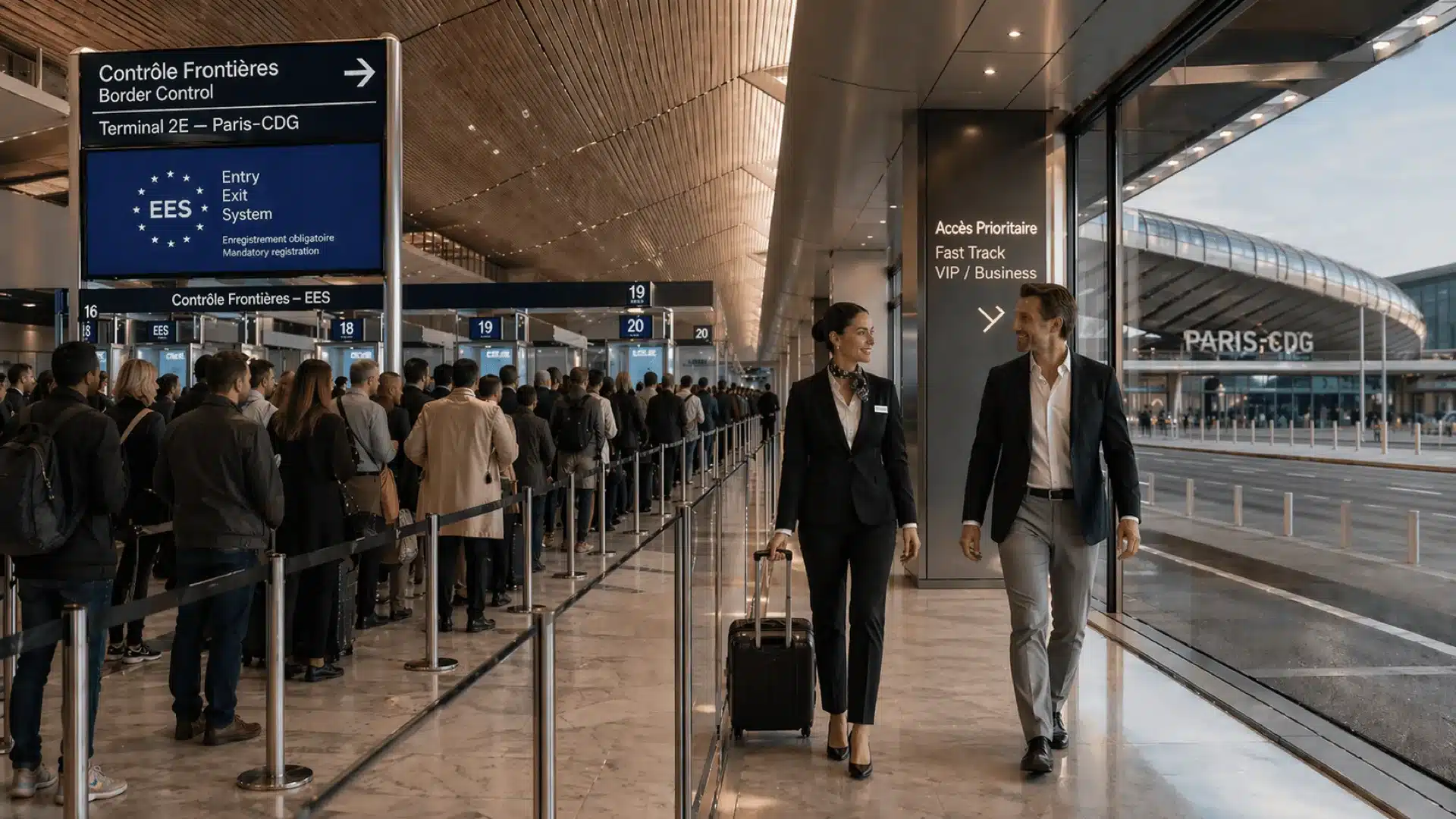
Emma lands at Charles de Gaulle Terminal 2E at 4:47 PM on a Wednesday. She has a 7 PM dinner reservation in the 8th arrondissement with a new client. At 7:27 PM, she is still standing in front of a biometric kiosk, watching the officer fumble with a scanner that will not read her UK passport. Her car, booked separately, is long gone. Her dinner is gone. Her evening is gone.
This is not a fluke. Since 10 April 2026, the EU's new Entry/Exit System, the EES, has turned Paris-CDG into the slowest major airport in Europe. Terminal 2E, the long-haul hub that receives most US and UK arrivals, is processing 35% fewer travelers per hour than forecast. Wait times at passport control now average two hours. On the worst afternoons of early April, they peaked above four.
If you are a non-EU traveler landing at CDG this spring or summer, the old plan, "build in 30 minutes for immigration", is obsolete. Here is what the EES is, why it broke the airport you thought you knew, and the three concrete ways our clients are skipping the queue.
What Is the EES, and Why Did It Break CDG?
The Entry/Exit System is a new European Union database that replaces the old passport-stamping ritual. Instead of a stamp, officers now record four pieces of data the first time you cross an external Schengen border: a scan of your passport, a digital photograph of your face, four fingerprints, and a timestamp. That data is stored in a central EU database for three years after your last entry, and pulled up automatically on every subsequent crossing.
The system went fully operational across 29 Schengen countries on 10 April 2026. You can read the official rules on the EU Travel portal and the European Commission's Smart Borders page.
In theory, the EES is faster than stamping once you are already in the database. In practice, every non-EU traveler has to register the first time, and at a hub like CDG, where ten long-haul aircraft can land in the same hour, that first registration is a bottleneck that nothing else can absorb. Each biometric capture takes between two and five minutes. Multiply that by 2,000 passengers landing in an afternoon bank, divide by the number of functioning kiosks, and you get the queue that is now making headlines.
Three structural problems are making it worse.
First, the kiosks are crashing. On the first weekend of the rollout, the automated stations at Terminal 2E went down repeatedly, and the Police aux Frontières (PAF) officers had to revert to manual stamping of passports they were not even supposed to stamp anymore. Second, the staffing model assumed a throughput that has not materialised. The afternoon arrival bank at 2E now processes roughly a third fewer travelers per hour than the pre-rollout projection. Third, Groupe ADP asked for a delay, the Paris airport operator publicly requested that the EU postpone EES enforcement until after the 2026 summer season. The request was denied.
The result: if you are landing at CDG between now and at least October, you are arriving into an airport that is structurally, predictably slow.
Terminal 2E Is the Worst, Here's the Data
Not all CDG terminals are equal under EES.
Terminal 1 handles Star Alliance long-haul, a smaller passenger bank, and has a better ratio of kiosks to travelers. Terminal 2A through 2D (SkyTeam and European short-haul) is manageable because many of those passengers are intra-Schengen and skip the EES entirely. Terminal 2G (regional and low-cost) is quiet. Terminal 3 (charter) is quiet.
Terminal 2E is the problem. It is where most direct flights from the United States, the United Kingdom, Canada, and the Middle East land, exactly the non-EU traffic that EES is designed to register. It is also where the afternoon arrival bank concentrates between 2 PM and 6 PM local time, when three or four wide-body aircraft touch down within 40 minutes of each other. That is when the two-hour queues happen.
A report published by VisaHQ on 20 April 2026 confirmed that 2E is processing about 35% fewer travelers per hour than the pre-launch forecast. At a hub that already handled 70 million passengers in 2024, that gap is not recoverable with more signage or more friendly reminders. It is a hardware bottleneck.
If you are booking a transfer from CDG into Paris and you land at 2E in the afternoon, build three hours into your plan, not the 45 minutes you were told by your travel agent last year. Or consider our dedicated EES Fast Track service, which gives you a personal escort through biometric control and onto the curb in roughly 15 minutes.
Who Has to Go Through EES (and Who Doesn't)
Not every traveler arriving at CDG has to queue at a biometric kiosk. Here is the short version.
You go through EES if:
- You hold a passport from a non-EU, non-EEA, non-Swiss country
- You are coming for a short stay (up to 90 days in any 180-day period)
- You are traveling for tourism, business, visiting family, medical treatment, or transit
- You are a child aged 12 or above (fingerprints + photo); children under 12 are photographed only
This covers most of our American, British, Canadian, Australian, Japanese, South Korean, Brazilian, and Middle Eastern clients, whether they arrive visa-free or with a Schengen visa.
You skip EES if:
- You hold an EU, EEA, or Swiss passport
- You hold a long-stay visa or French residence card (carte de séjour)
- You are a diplomatic passport holder
- You are a cross-border worker registered under a special scheme
EU and EEA passport holders can also use the PARAFE e-gates at CDG, which remain fast and typically clear in under a minute. Some non-EU nationals have conditional PARAFE access: UK passport holders, for example, have been eligible since late 2020, but the gates only work on subsequent entries, the first EES registration still has to be done at a manned kiosk. The UK government's EES guidance has the latest on British access.
A word on ETIAS. ETIAS is not EES. ETIAS is the EU's online pre-travel authorisation, a separate system, expected to launch in late 2026 or early 2027, that will require visa-exempt travelers (including US, UK, Canadian, and Australian nationals) to apply online before flying, pay roughly €7, and receive a three-year multi-entry authorisation. ETIAS is a form you fill out at home before travel; EES is a biometric capture at the border. You will eventually do both. This article is about the one happening now.
3 Ways to Skip the EES Queue at CDG
Nobody loves a queue, but the EES queue is particularly punishing because it is unpredictable and unmoveable. You cannot pay for priority at the kiosk itself; the biometric capture is the same for everyone. What you can do is change how, when, and with whom you approach it.
Here are the three strategies that actually work.
Strategy 1, Arrive Off-Peak
The afternoon bank at 2E is the trap. If your itinerary is flexible, pick a flight that lands before 10 AM or after 9 PM local time. Morning arrivals from the US East Coast (the 7-9 AM bank) still see queues, but they clear faster because fewer flights land simultaneously. Late-evening arrivals (after 9 PM) are the fastest window of the day, you will often clear EES in under 30 minutes.
The Chen family, a couple with two children traveling from San Francisco on April 15, made this calculation. They shifted their return leg to a 6 AM landing and were in their hotel before 8:30 AM. Their outbound to Avignon connection via TGV, which they had booked for a tight window, made it with 40 minutes to spare. Adjusting the flight was free. Adjusting the consequences of a missed connection would not have been.
Who this works for: flexible travelers, families, anyone with no fixed landing time. Who this does not work for: business travelers with meetings, anyone connecting to a tight departure, anyone flying a carrier that only operates afternoon banks out of their origin.
Strategy 2, Standard Fast Track
Paris airports sell a "Fast Track" service, a ticket, typically €30 to €50 per person, that lets you use a priority lane at passport control. Some airlines include it with business class. Some VIP services resell it at a markup.
Fast Track helps, but it has a catch under EES. The priority lane still ends at a biometric kiosk. If that kiosk is the slow step (and it is), your €30 ticket saves you the line in front of the kiosk, not the time at the kiosk itself. In practice, Fast Track at CDG under EES saves between 15 and 40 minutes compared to the standard queue, useful, but not transformative.
Our own standard CDG Fast Track is priced at this tier and still gets you a meaningful time saving. We recommend it for leisure travelers without tight connections.
Who this works for: travelers with a 90-minute buffer who want the queue shorter but do not need it gone. Who this does not work for: executives arriving for a same-day meeting, families worried about keeping young children patient, anyone connecting onward.
Strategy 3, VIP Meet & Greet With Personal Escort
This is what our clients actually book, and the reason the luxury-travel industry saw VIP bookings at CDG jump 40% between 11 and 20 April.
A VIP Meet & Greet is not just a priority lane. It is a dedicated bilingual greeter who meets you at the aircraft door or the jet bridge, walks you through a separate PAF channel reserved for assisted passengers, carries or coordinates your luggage, and hands you off to your chauffeur at the curb. The greeter is the one managing the biometric moment, pre-filling what can be pre-filled, coordinating with the officer, and keeping the rest of your group moving together.
The math is different from Fast Track. Under EES, a VIP Meet & Greet at CDG gets you from aircraft to chauffeur in roughly 15 to 25 minutes, regardless of whether the standard queue is 30 minutes or three hours. That consistency is what the service sells.
Marcus, a New York-based consultant who flies to La Défense every six weeks for a client retainer, described it like this after his first post-EES trip: "The first time the extra €250 has paid for itself in one afternoon. I had a 10 AM meeting. Without the greeter, I would have been an hour late. That hour would have cost me more than a year of Meet & Greet bookings."
Our VIP Meet & Greet at CDG starts at €250 for two passengers (€50 for each additional person), covers all CDG terminals, and includes one hour of post-landing waiting time, real-time flight monitoring, luggage porter service, and free cancellation up to 24 hours before. A combined Meet & Greet plus Mercedes chauffeur transfer to your Paris hotel starts at €390.
Who this works for: business travelers, families with young children, first-time European visitors, anyone connecting to a train or another flight within three hours, anyone who simply values a predictable arrival over a cheap one.
What Happens After Your First EES Registration
One silver lining in the EES story: you only get your fingerprints captured once.
Your biometric record is stored in the central EU database for three years after your last crossing. On every subsequent entry into the Schengen area, officers pull up the existing record, take a fresh facial image for verification, and wave you through. The second time is measurably faster than the first, typically under two minutes at the kiosk, compared to four or five for an initial registration.
This matters for frequent travelers. A US executive who flies to Paris four times a year will only register once, then pass quickly on the next eleven visits within the three-year window. A UK family that takes an annual ski trip to the Alps will register on their first EES crossing and roll through smoothly thereafter.
It does not help anyone on their first post-April 10 visit, which is what the current queues are made of. But if your EES record is already in the system from an earlier business trip, you are in the easy group. Budget 45 minutes for passport control instead of two hours, and plan accordingly.
One small catch: if the kiosk fails to match your face to your stored record, because of lighting, glasses, a beard grown since last time, or simple bad luck, you will be redirected to a manned counter for manual verification. This is rare but happens. A VIP greeter makes the re-verification painless; a lone traveler usually just loses ten minutes.
Booking Ahead: the Detail That Matters
Whichever strategy you choose, book before you fly. VIP Meet & Greet operators at CDG, including us, need a minimum of 48 hours to confirm the greeter roster, coordinate with Groupe ADP, and set up the PAF handoff. Last-minute same-day bookings are sometimes possible but cost more and are not guaranteed.
For arrivals in peak summer (late June through August), our recommendation is to book four to seven days ahead. Our Paris-CDG greeters work across all five active terminals (1, 2A-2D, 2E, 2F, 2G, and Terminal 3 seasonally), and we hold one hour of post-landing waiting time in every booking as standard, so a delayed flight never becomes a cost issue for the client.
If you are planning your Paris trip now, you can book your CDG Meet & Greet directly or pair it with a standard Mercedes chauffeur transfer from CDG to cover both the border and the city drive in a single booking.
Frequently Asked Questions
Does the EES apply to me if I have a UK passport?
Yes. UK citizens are classified as non-EU third-country nationals under EES rules and must register biometric data on their first entry after 10 April 2026. The registration is valid for three years. UK holders can use some PARAFE e-gates on subsequent entries but not for their initial EES capture.
How long should I budget for passport control at CDG right now?
For non-EU arrivals at Terminal 2E in the afternoon bank, plan three hours between landing and any onward booking (dinner, meeting, train, connecting flight). For morning or late-evening arrivals, 90 minutes is usually sufficient. EU passport holders using PARAFE typically clear in under 10 minutes.
Does a VIP Meet & Greet actually skip the EES queue, or just the line?
It skips both. A Meet & Greet at CDG uses a dedicated assisted-passenger channel operated in coordination with the Police aux Frontières. The biometric capture still happens, EES is mandatory, but it is processed at a priority kiosk with no queue in front of it, reducing the whole border experience from two hours to roughly 15 to 25 minutes.
Do my children need to do the EES registration?
Children under 12 are photographed but do not have fingerprints taken. Children aged 12 and above go through the full biometric capture like adults. All children of non-EU nationality need to be registered on their first EES crossing, regardless of age.
Is ETIAS the same as EES?
No. EES is a biometric registration that happens at the border, in person, on arrival. ETIAS is an online travel authorisation you will apply for before flying, expected to launch in late 2026 or early 2027, costing roughly €7 and valid for three years. Visa-exempt travelers to the Schengen area will eventually need both.
How far in advance should I book a CDG Meet & Greet?
A minimum of 48 hours ahead to guarantee availability. For peak summer arrivals (late June through August), book four to seven days ahead. Last-minute bookings are sometimes possible but carry higher pricing and cannot be guaranteed on the busiest afternoons.
The EES is not going away. The queues at CDG are not a launch glitch; they are the steady state of an airport structurally under-equipped for the new process, and Groupe ADP has already signaled that significant relief is unlikely before October. The sensible plan, if you are landing in Paris this season, is to decide which of the three strategies fits your trip, and to make the choice before you board, not after you land.
If you are arriving at CDG soon and want a predictable, door-to-door experience, book your CDG Meet & Greet and chauffeur transfer now. Add Meet & Greet at checkout from €250, pick your Mercedes from €140, and treat the EES as someone else's problem.